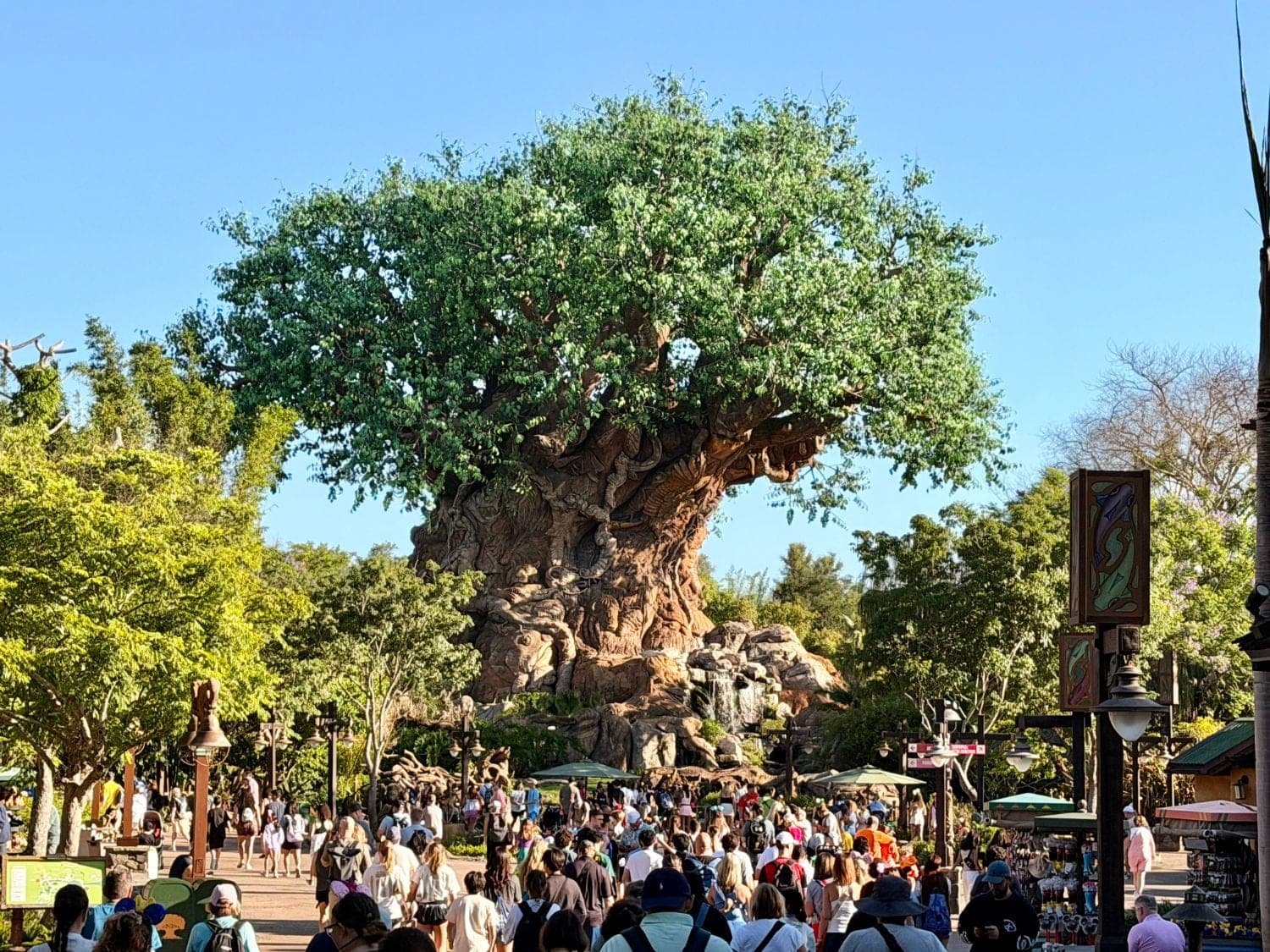
The Art of Waiting: Why We (Gladly) Queue for Some Rides
Sixty minutes of waiting — and yet the time simply flies by? No coincidence: behind every good queue lie psychology, storytelling and hard-nosed capacity math. A deep dive from the pre-show to Little's Law — and, right in the middle, the reason park.fan exists.
Every park fan knows the moment: you round the corner toward your favorite attraction — and there it is on the sign, glowing: "60-minute wait." On some days you spin on your heel and inform your companion that the ride is "honestly overrated anyway." On others you stand in that exact same 60-minute line and would swear afterward it was 25 at most.
That's no coincidence and no self-delusion — both times you were the same person in the same line. It's the product of two disciplines that mesh perfectly in a good park: the psychology of time perception and the mathematics of capacity. One decides how the wait feels. The other, how long the line really is.
And if you've read our origin story, you can probably guess why this topic won't let go of me: park.fan was invented in a Taron queue, out of pure frustration over what felt like an eternity. This article is, in a sense, the autopsy of that afternoon — the question of what was actually happening to me back there. Time for a deep dive into both disciplines. Promise: exactly two formulas appear, and the two of them fit together on the back of a single beer mat.
The psychology of time: why minutes stretch
The Harvard economist David Maister dissected the core problem back in 1985 in his classic "The Psychology of Waiting Lines". His first and most important rule: Unoccupied time feels longer than occupied time. If all you do is stare at the back of the person in front of you, the clock crawls. If you have something to see, hear or do, it keeps ticking at almost normal speed.
On top of that come three more Maister rules that every park planner knows by heart:
- Uncertain waits feel longer than explained waits. That's why the queue is marked every few meters with "time remaining" signs, and a wait-time display hangs at the entrance — which, by the way, loves to lie to you, but more on that shortly.
- Unfair waiting is unbearable. Nothing ruins the mood faster than the feeling that others are slipping past — the reason parks route their express lanes as discreetly as physically possible. What the eye doesn't see, the queue doesn't resent.
- Waiting for something valuable is easier to endure. The greater the anticipation, the more patient the line. We won't stand 20 minutes for a fairground flat ride. For the new mega-coaster, we'll happily talk ourselves into 90.
Your sense of time exaggerates — by a good third
Just how badly we judge unoccupied waiting can be measured: in the field experiments of marketing researcher Jacob Hornik, people waiting overestimated the time that had actually elapsed by around 36 percent on average — ten measured minutes become almost fourteen in your head. Your inner clockmaker, in short, is a virtuoso of rounding up — and it always rounds against you. And back in 1991, the MIT queueing researcher Richard Larson and colleagues showed, under the lovely title "Entertain, Enlighten, and Engage", that even simple distraction — in the experiment, a news screen in a bank branch — markedly improves the perceived quality of the wait.
The mechanism behind it: our brain can only count time meticulously when it has nothing else to do. Once attention turns to music, theming details or a show, the internal counter simply runs out of resources — and the overestimation melts away. That's exactly what everything you see in a good queue is designed to exploit: soundtracks, animatronics, interactive elements, hidden details. That's not decoration. That's applied cognitive psychology.
Pre-shows: the experience begins before you board
The most elegant weapon against dead time is the pre-show — it simply redefines the wait as part of the attraction. The textbook example stands in Disney's Hollywood Studios: at the Tower of Terror(Disney's Hollywood Studios, USA)Closed you don't shuffle through a corridor, but through the dusty lobby of the Hollywood Tower Hotel into a library, where a video in the style of "The Twilight Zone" tells the building's story. You essentially check into a hotel that you'll later check out of in free fall — and you never notice that you're currently "playing" queue. Technically, you're still waiting. But it feels like the ride began long ago. The European counterpart, by the way, stands in Paris at Disney Adventure World — with the same dramaturgy: The Twilight Zone Tower of Terror.
The peak-end effect: the last few meters count double
The psychologist and Nobel laureate Daniel Kahneman showed that our memory doesn't rate experiences as an average, but by two points: the emotional peak and the end — the so-called peak-end rule. For queues, that means: the last minutes before boarding shape the memory of the entire hour that came before. That's why the finale of a queue is almost always the most elaborately staged part — the densest theming, the best animatronic, the goosebumps moment all come just before the station. When the ending is strong, your memory forgives the sluggish middle stretch remarkably willingly — a principle familiar to anyone who's ever recommended a mediocre film on the strength of a great finale.
When the queue itself is the show
Just how far you can push this principle is shown by two modern masterpieces — both in Orlando, both with queues that people voluntarily show up early for.
Avatar Flight of Passage: a museum as a queue
The queue for Avatar Flight of Passage(Disney's Animal Kingdom Theme Park, USA)Closed in Disney's Animal Kingdom is essentially a walk-through museum with a flight-simulator exit: first the path winds through the landscape of Pandora and caves with Na'vi paintings, then through an abandoned research lab — complete with a life-sized avatar floating in an amnio tank, breathing so convincingly that people regularly stop dead and hold up the line. A queue that clogs itself because it looks too good: you can't pay a higher compliment. After that come no fewer than two pre-show rooms, in which you're "scanned" and "linked" to your own avatar.
This is doubly clever psychologically: the story rooms meter the crowd into groups and turn the final quarter-hour — precisely the phase the peak-end rule says is remembered most strongly — into part of the attraction. And they're also the capacity backbone: you fly in theater-like Link Chambers with 16 seats per level, three levels stacked, four theaters running in parallel — just under 200 guests at once, around 1,400 per hour. Even after a 120-minute wait, most people afterward don't talk about the line, but about the breathing avatar in the tank.
Cosmic Rewind: first the museum, then the coaster
EPCOT takes it one step further with Guardians of the Galaxy: Cosmic Rewind(EPCOT, USA)Closed. The attraction sees itself as a complete "pavilion" experience: on the way to the ride you pass through the Galaxarium, a planetarium-like exhibition about Xandar and Earth, followed by a briefing from the Nova Corps. The ride itself — a story coaster with freely rotating vehicles and a backward launch — is the finale of a production that began twenty minutes earlier.
The capacity side is remarkable too: Cosmic Rewind opened in May 2022 completely without a classic standby line — for 836 days straight, access was exclusively via a virtual queue through the app. For two and a half years, EPCOT's most famous line was one nobody ever stood in — a queue that hadn't earned its own name; a permanent standby queue only arrived in early 2025. The physical line existed essentially only as a story path, not as holding space — and that for a ride that moves around 2,000 guests per hour with trains of 20.
VelociCoaster: Waiting in the Raptor Paddock
Universal plays the same card at Jurassic World VelociCoaster(Universal Islands of Adventure, USA)Closed in Islands of Adventure, only with teeth. The queue runs straight through the Raptor Paddock from Jurassic World: past ripped-open enclosure fences, animatronic raptors within arm's reach and a leafy atrium where even the concrete walls look like Isla Nublar. You're not waiting for a coaster, you're on a paddock tour that just happens to end in a quadruple launch. That's exactly what Maister means by "occupied time": time that's kept occupied feels shorter — and anyone busy checking whether the raptor behind the fence really did just turn its head isn't glancing at their phone every ten seconds.
And then there's perhaps the most honest capacity trick of them all: the single rider lane. Anyone riding alone who lets themselves be slotted into the odd free seat that a group of four leaves open not only drastically cuts their own wait time — they help the park fill every car to the brim. Every otherwise empty seat is wasted capacity; the single rider lane is the elegant way to plug those gaps. A rare case in which self-interest and throughput pull in exactly the same direction.
Shows: the quiet capacity helpers
And then there's one more trick that doesn't happen at the attraction at all: entertainment as a crowd sponge. A parade, a fireworks show or a stunt show ties up thousands of guests in one stroke — people who, for that hour, aren't standing in a single ride queue. The amphitheater for Fantasmic! at Hollywood Studios holds close to 10,000 people per show between standing and seated spots — so a single show "swallows" an entire wave of visitors: ten thousand people who, for the next half hour, are guaranteed to be sitting somewhere other than in front of your favorite coaster. The wait times across the rest of the park visibly exhale in response. On the live charts at park.fan you can watch this effect in real time: during the big evening show, the headliners' wait times measurably dip — and if you've already seen the show, that's the cheapest hour of the day to ride. It's for exactly these moments that we update wait times every minute.
Capacity and throughput: the mathematical secret
So much for perception. Now for the hard currency of every queue: throughput — how many people an attraction actually carries per hour.
The basic formula — known in the industry as THRC (Theoretical Hourly Ride Capacity) — is simple:
Throughput = seats per dispatch × dispatches per hour
The word "theoretical" is meant seriously: the calculation assumes every seat is filled and nothing jams — it knows nothing of the family that only decides who sits next to whom once they're at the train, nor of the one loose shoe that holds up the dispatch. The real, operational throughput is therefore practically always lower. The formula gets interesting because parks combine the two factors in completely different ways — by the buffet principle or the tapas principle. Two rides from Orlando that delivered almost identical numbers on paper illustrate it perfectly:
Example A — the buffet. The Incredible Hulk Coaster(Universal Islands of Adventure, USA)Closed in Universal Islands of Adventure goes for large portions: eight cars, four people side by side — 32 seats per dispatch. With a dispatch roughly once a minute, the ride lands at a theoretical capacity of 1,920 people per hour (32 × 60). A single train swallows more people at once than fit inside many a dark ride at the same time.
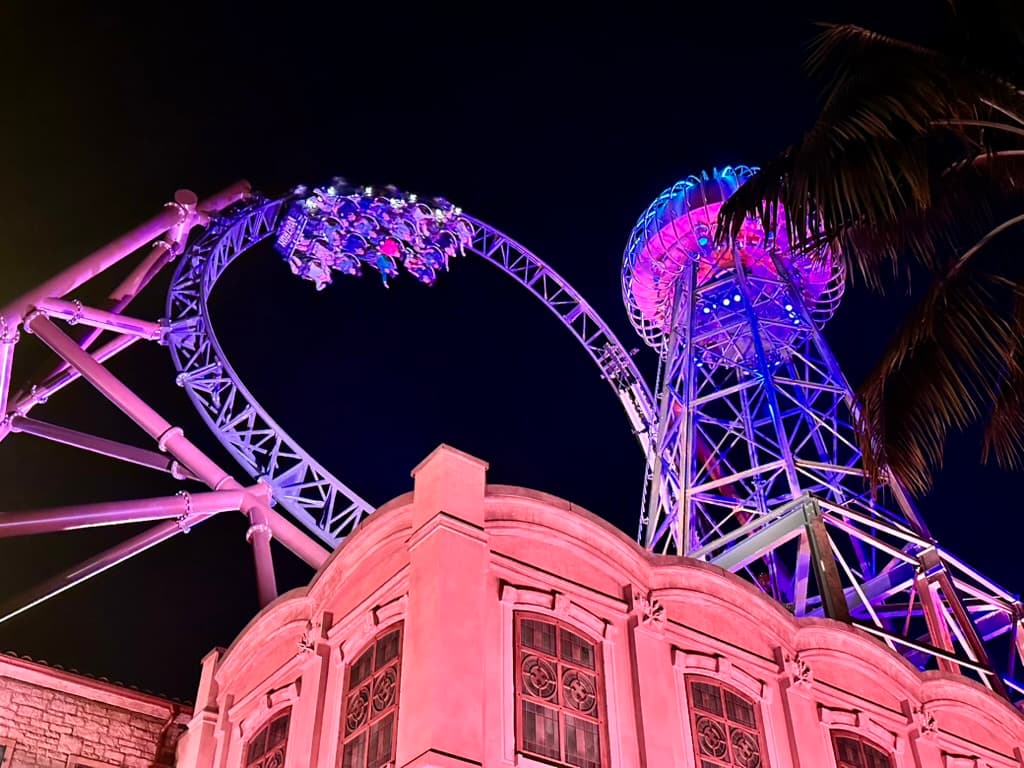
Example B — the tapas bar. The opposite model ran right next door until August 2025: Hollywood Rip Ride Rockit(Universal Studios Florida, USA)Closed in Universal Studios Florida sent small cars with just 12 seats onto the track — but at what felt like a dispatch every few seconds. To reach a comparable ~1,850 people per hour, seven cars were in circulation at once, and the station had to dispatch nearly three times as often as the Hulk. Same result, completely different operating concept. (The ride is history now — its plot is making way for the successor, Fast & Furious: Hollywood Drift.)
Block sections: why not just "more trains"?
Seven cars at once — that raises the question of why they don't eventually slide into one another. The answer is the block system: the track is divided into sections, and only one train may ever be in each section. Only once the block ahead is clear does the control system release the next one. For that, every block needs a spot where a train can, if necessary, come to a complete stop.
So more trains don't automatically mean more throughput: without enough block sections, the trains pile up in front of the station — enthusiasts know the dreaded "stacking." The train hangs in the final brake, the riders wave to the station, the station waves back, and nobody moves. In the end, the bottleneck is almost always the dispatch: how quickly are all the restraints checked and the train back out?
Just how seriously modern coasters take this is shown by Voltron Nevera at the Europa-Park: according to the manufacturer's factsheet from Mack Rides, seven trains run at once there, with a target dispatch of one departure every 36 seconds — that makes 1,600 guests per hour, even though a train holds only 16 people. Frequency beats size.
Standing still is the enemy: rolling launches & rolling stations
The latest escalation of this thinking: trains that don't stop at all anymore. Voltron uses rolling launches — the trains aren't halted before the launch and then fired off, but accelerated on the roll, "flying" like a baton pass in a relay race. To let the LSM motors sustain that on a 36-second cycle, Mack simply gave them four rows of stators instead of two. Every stop avoided means: the block clears faster, the rhythm holds, the line keeps rolling.
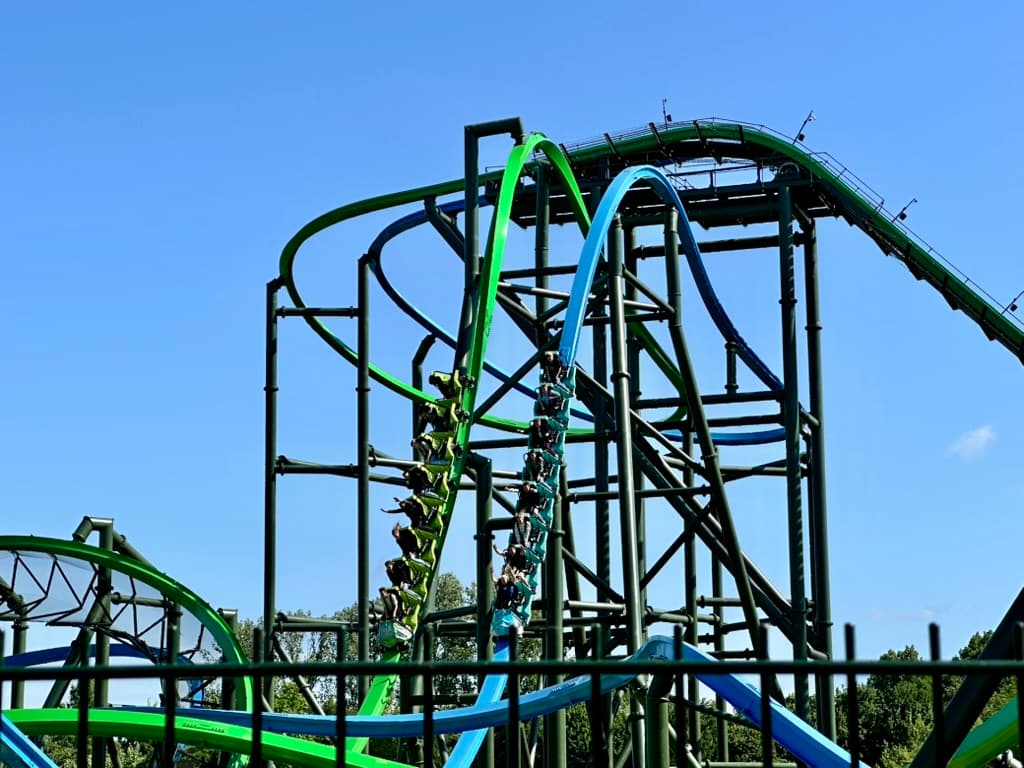
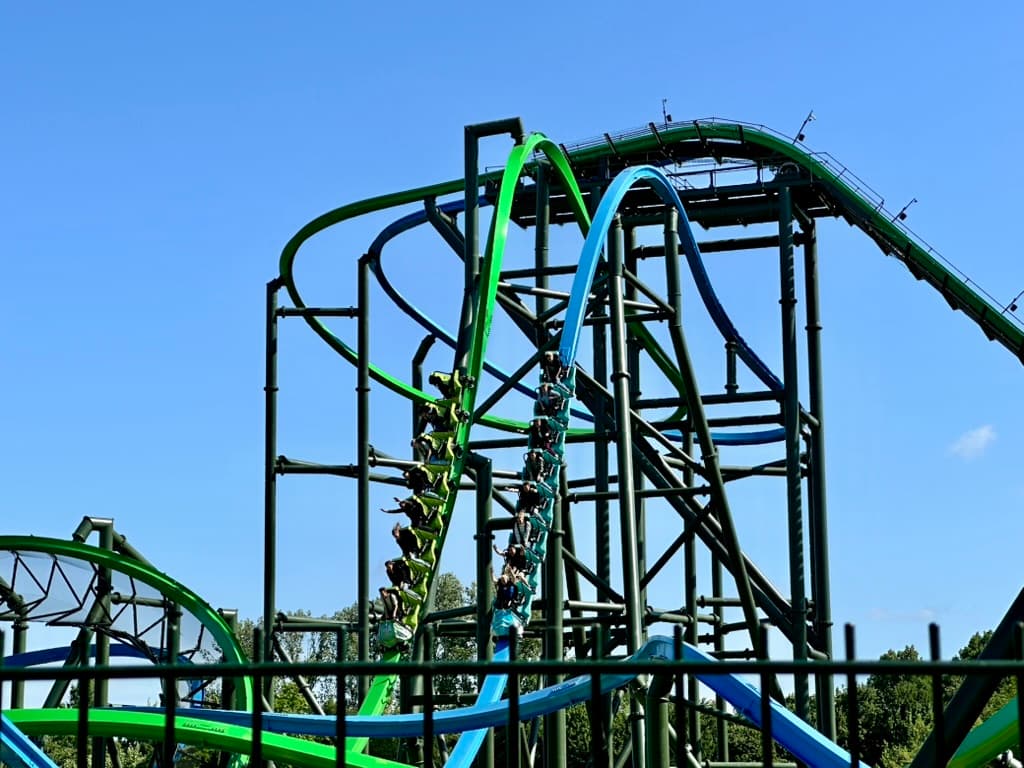
And in 2025 Walibi Holland transferred the same principle to the station: at YOY — Europe's first single-rail dueling coaster, where you choose between the sister tracks YOY Thrill and YOY Chill — the trains don't stop in the station at all anymore. They roll through at walking pace while guests board: a rolling station, essentially the omnimover principle applied to roller coasters. With just eight seats per train (single file, like on a very determined bicycle), every second the train isn't standing still counts.
Little's Law: the formula behind every wait-time display
And with that, to the formula that holds it all together — one of the most elegant results in queueing theory. In 1961, the MIT professor John D. C. Little proved the relationship that today bears the name Little's Law:
L = λ × W — the number of people waiting (L) equals the arrival rate (λ) times the wait time (W).
For a park visit, you simply rearrange it:
Wait time = people in line ÷ throughput
If 640 people are standing in front of the Hulk and the ride manages 1,920 per hour, you wait 20 minutes (640 ÷ 1,920 = ⅓ of an hour). Those same 640 people in front of a ride with a capacity of 800? 48 minutes. The elegant thing about Little's formula: it holds for any stable line — no matter how irregularly the guests trickle in. And it's exactly this calculation — in refined form — that sits behind every wait-time display: parks estimate the number of people waiting and divide by the current throughput, or they measure the time directly, for instance with timing cards that a guest receives at the entrance to the line and hands back in at the station.
The formula also explains why the same line length can mean completely different wait times on two different days: if a ride runs two trains today instead of three, λ drops — and W rises immediately, without a single extra guest being in the park.
Which brings us to the lying display from earlier: the precisely calculated number often gets a generous safety margin added on top. Not (only) out of sloppiness, but out of pure psychology — someone who expects 60 minutes and boards after 45 leaves the station a winner. Peak-end rule, remember: the experience ends better than expected, and that's exactly how it gets filed away. So the display really does lie — but it lies for you.
At this point let me chat briefly from the engine room, because this is exactly where park.fan lives: our live wait times show you, minute by minute, what L and λ are really doing right now — and when our AI model forecasts wait times up to 365 days in advance, at its core it models nothing other than these two quantities: demand (how many people want to reach this ride today?) and throughput (how many can it clear?). Little would probably be amazed at all the things his formula gets used for today. And because we only trust numbers when they have to prove themselves: how often our forecasts hit reality is public on the how-to page — no cheating possible.
Why Peter Pan's Flight always "escalates"
Which brings us to one of the oldest riddles in the park world: why does Peter Pan's Flight of all rides — a cozy dark ride of 1955 vintage, no coaster, no thrill — show a practically permanent 45+ minutes on the display in virtually every Disney park in the world, from Disneyland Paris all the way to Orlando?
The answer lies entirely in the math from above:
- Pirate ships are not mass transit. Peter Pan's Flight in Paris sends 16 galleons over London, and each one holds — counting generously — five people. That's the carrying capacity of a mid-sized elevator, spread across an entire night sky. Unofficial counts land at around 1,200 guests per hour, and the original version in the Magic Kingdom manages only about 800 — a single Hulk train carries twice as many people per dispatch as Peter Pan has ships. And for a comparison within its own house: Pirates of the Caribbean right next door, with its big boats, swallows almost four times as many.
- Saturation from breakfast onward. As soon as demand reaches maximum capacity (saturation = 1.0), the line keeps growing linearly with every additional guest — it can only start shrinking again once fewer people arrive than the ride clears. With a capacity ceiling this low, that point isn't reached at noon, but roughly when the second tour bus pulls up.
- The line as a seal of quality. And now psychology comes back into play: visitors read a long line as proof that the ride must be worth it — the same logic by which, on vacation, we sit down at the restaurant with the fullest terrace. So everyone joins all the more eagerly, and the wait time becomes a self-fulfilling prophecy.
The phenomenon is measurable worldwide, by the way — here are the live wait times for the Orlando version in the most-visited park in the world, straight from our data and as unvarnished as ever:
Europe waits differently: Phantasialand & Europa-Park vs. Orlando
How strongly demand and capacity determine the wait-time level of an entire park is seen most clearly in a comparison of the heavyweights — Europe's big parks against the Orlando giants.
Orlando plays in a demand league of its own. The Magic Kingdom is the most-visited theme park in the world, and Disney and Universal alike draw guests from every continent. On top of that comes a factor Europe barely knows in this severity: paid line-jumping. Lightning Lane and Express Pass sell part of the capacity to paying guests — and every express ride is one missing from the standby line. The result: headliners like Avatar Flight of Passage regularly sit at 60 to 120 minutes despite massive hourly capacity.
The Europa-Park is the counter-model. Germany's largest park — the most-visited in Europe after Disneyland Paris — spreads its roughly six million guests per year across thirteen roller coasters plus dozens of themed rides. This sheer amount of parallel capacity acts like a pressure-relief valve: demand disperses, and hardly any line runs into permanent saturation. That's why even busy days in Rust rarely feel like Orlando — only new rides like Voltron regularly crack the 60-minute mark.
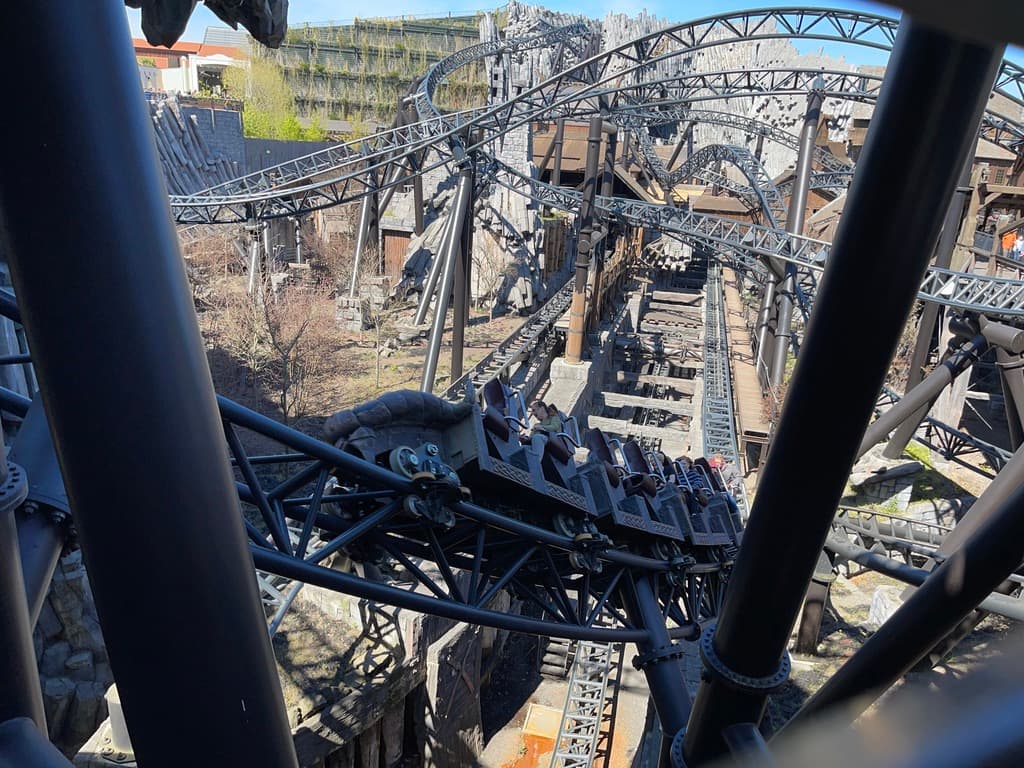
Phantasialand, on the other hand, is the extreme case in the opposite direction: one of the most compact major parks in Europe, with few, but extremely elaborately themed attractions. The load concentrates on a handful of headliners — and when everyone wants to ride Taron on a holiday Saturday (shout-out to me — experience says I'm reliably one of them), saturation is reached just as fast as at Peter Pan in Paris. A small crowd, it turns out, is no protection against long lines when the concurrency of the attractions is limited — the math is the same, only the scale is smaller.
These very profiles are the reason every park page on park.fan shows the long-term statistics alongside the live wait times — because "busy" is relative: 45 minutes is a bad day in Brühl and a gift in the Magic Kingdom. Take a look at the same dataset for both parks — typical wait times by month and weekday, from the last two seasons.
First, the Phantasialand in Brühl — the compact extreme case: when a number climbs here, it climbs steeply, because everything concentrates on a few headliners.
And now the Magic Kingdom in Orlando — the most-visited park in the world: a higher baseline load, but spread more broadly across dozens of attractions. Notice how differently even the "typical" minutes and the seasonal curve look over the course of the year.
Two parks, two completely different wait-time signatures — and it's exactly these patterns that our model learns from to know when a visit is worth it.
Shuffling forward gets you nowhere — and even slows the line down
A little self-experiment for next time: you're standing in the line, and a two-meter gap opens up in front of you. What does your body do? It shuffles forward. Instantly, reflexively, as if someone might otherwise steal the gap. And that is — with all due respect — utterly pointless.
Because Little's Law from a moment ago says it crystal-clear: your wait time depends on the throughput of the station up at the front, not on the distance to the person ahead of you. Whether you scoot up close to them or leave two meters of air, your position in the line changes by exactly zero places. You move two meters — but you don't arrive at the front a single second sooner for it.
Worse still: the collective shuffling forward actually makes the line measurably slower. It's the same physics as the highway traffic jam that seems to appear out of nowhere. The physicist Yuki Sugiyama sent 22 cars around a circular track with the single instruction to drive at a constant speed and an equal distance apart — within a few minutes, with no bottleneck whatsoever, a stop-and-go jam formed that ran backward through the column. MIT mathematicians call these self-sustaining waves "jamitons," because they behave like detonation waves. In dense crowds, exactly the same thing happens — and there, such backward-running waves are even a dreaded early-warning sign.
The culprit is the start-up lost time that everyone knows from traffic lights: when the light turns green, the whole column doesn't set off at once — each driver reacts about a second after the one ahead, and the rearmost car only starts rolling noticeably later. Every time your line jerks forward, the same staggered reaction time goes up in smoke. Twenty jerk cycles, times sixty people waiting — and a surprising amount of nothing adds up.
The astonishing consequence: if everyone simply kept moving steadily and slowly instead of standing, shuffling up and standing again, the line would move more smoothly and, on average, faster. Less jostling, more flow. Traffic research knows this as the "faster-is-slower" effect: whoever pushes harder at a bottleneck lowers the throughput, because everyone wedges into one another — a result Dirk Helbing demonstrated in Nature back in 2000. The one condition: you have to stay below the critical density. And that is exactly why keeping your distance helps more than shuffling forward.
And now the punchline: the parks solved exactly this problem on the vehicle side long ago. The Haunted Mansion's omnimover and YOY's rolling station never stop — no halt, no start-up lost time, maximum flow. Only the guests in the line in front of them are the last stop-and-go system nobody has designed away yet. Until that day comes, the most honest lever is the one you hold in your own hands anyway: don't shuffle in closer, but come in the first place on a day when the line never runs into a jam at all — and which day that is, the best-days calendar further down will tell you.
Modern solutions: virtual queues and double stations
Because physical capacity can't be increased at will, parks increasingly move the waiting to where it doesn't hurt: onto your phone.
The Europa-Park introduced its VirtualLine at the start of the coronavirus pandemic in 2020 — and kept it, because it simply works: through the park app you reserve a free time slot for attractions like blue fire, Wodan or Voltron. For years, Disney ran mega-new-rides like Rise of the Resistance or, indeed, Cosmic Rewind entirely via boarding groups. The principle is always the same: you queue up digitally while you eat, shop or watch a show — the line still exists, it just takes place without your legs. The wait doesn't vanish, but it no longer devours your day, and the park distributes demand more controllably across the hours.
On the hardware side, parks work in parallel on dispatch speed — with three classic patterns:
- Separate unload and load areas, so the train doesn't have to wait for people to get off before the next group boards.
- Double stations, where the track forks into two parallel platforms in front of the station: one train is loaded while the other is dispatched — a trick that Vekoma's Flying Coasters needed because of their long load times, for instance, and that Efteling also uses on the water coaster De Vliegende Hollander.
- Two complete tracks at once: Disney's Space Mountain in the Magic Kingdom is the most radical example — two interlaced, mirror-image tracks ("Alpha" and "Omega") run inside the same building with their own stations, which practically doubles the system's capacity — effectively two roller coasters passing themselves off as one, and most guests never notice. The blueprint came in 1959 from the Matterhorn Bobsleds at Disneyland, the world's first roller coaster with tubular steel rails — likewise with two tracks.
And the undisputed champion of throughput does without a station entirely: on the omnimover — Disney's continuous chain of vehicles, as used by the Haunted Mansion, for instance — the belt never stops. Boarding and exiting happen on the moving vehicle, and the attraction thereby swallows over 3,000 guests per hour, more than many a mega-coaster — with a chain of vehicles that has been circling uncomplainingly since the sixties and never once asks for a break.
Conclusion: the display only tells half the story
This article won't make the next 60-minute line any shorter. But you'll read it differently now — and that very reading is the heart of park.fan. Every feature of the site answers one of the questions from above:
- How long is the line really, right now? That's what our live wait times are for — over 150 parks, 5,000+ attractions, minute by minute. Little's Law in real time, without you having to count the 640 people ahead of you yourself.
- Is that a lot right now, or normal? The long-term statistics for every attraction will tell you — because 45 minutes, as we've seen, is either an annoyance or a lottery win depending on the park.
- And do I even have to stand in line at all? That's usually decided when you pick the day. That's what the best-days-to-visit calendar is for, with forecasts up to 365 days in advance — for the Europa-Park, for example:
The only thing we can't do anything about is the psychology: whether the hour feels like an hour or like a first act is decided by pre-shows, theming and the peak-end effect — and by the parks that have mastered this craft. So the next time you're standing in a lovingly themed queue and the time passes strangely fast: that's no accident. That's design. Enjoy it — you're part of a pretty magnificent illusion. And whether it's worth it, the data will tell you beforehand.
— Patrick
P.S.: Yes, I still stand in line for Taron anyway. But now I know, to the minute, exactly how unwise that is right now — and I've got it in writing that my sense of time is exaggerating by 36 percent while I do.
Sources & further reading
- David Maister: The Psychology of Waiting Lines (1985)
- Katz, Larson & Larson: Prescription for the Waiting-in-Line Blues: Entertain, Enlighten, and Engage (Sloan Management Review, 1991)
- On the ~36% overestimation (Hornik 1984): Consumer Perception and Evaluation of Waiting Time: A Field Experiment (Journal of Consumer Research)
- Alex Stone: Why Waiting Is Torture (New York Times, 2012)
- Daniel Kahneman et al.: Peak-end rule
- John D. C. Little: A Proof for the Queuing Formula L = λW (Operations Research, 1961) — Little's Law explained
- On the phantom traffic jam: Sugiyama et al., Traffic jams without bottlenecks (New Journal of Physics, 2008) · MIT "jamitons"
- On the "faster-is-slower" effect: Helbing, Farkas & Vicsek, Simulating dynamical features of escape panic (Nature, 2000)
- Technical data: The Incredible Hulk Coaster, Hollywood Rip Ride Rockit and YOY on RCDB · Mack Rides factsheet for Voltron Nevera · The tech behind Voltron (Coaster101) · YOY with a rolling station (Freizeitpark-Welt)
- Capacity deep dives: THRC vs. OHRC at Disney World · Flight of Passage facts at TouringPlans
- Europa-Park: VirtualLine (official)
Enjoying park.fan?
Make us a preferred source on Google in one click — park.fan wait times and guides then rank higher in your search results.
More from the blog
Some projects start with a business plan. This one started with a stroller at a fairy-tale lake, a gondola ride through "1001 Nights" — and the question of whether sixty minutes in the Taron queue are actually worth it. The story of a passion project that learned to read theme-park days.

From the continent's "biggest" Halloween event at Movie Park, through the uncompromising Traumatica, to the notorious Walibi Experiences — for which people voluntarily pay 20 to 25 euros extra to go through things they'd rather not talk about afterwards: the big — and, honestly, rather gleeful — overview of the 2026 Halloween season in Germany, the Netherlands, Belgium and France. Complete with the two top parks that pointedly sit the whole circus out, and the question of when it gets busiest.